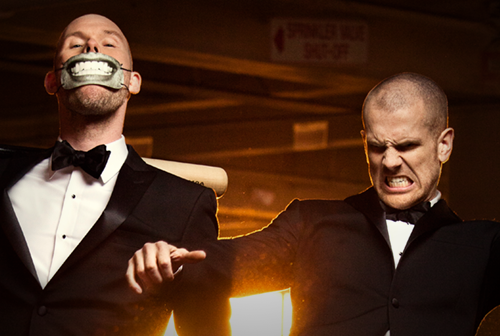



Myagi's sets have become renowned as one of a kind experiences not to be missed. Just as comfortable on a festival stage as in a club, through a wide variety of countries each year with nothing but glowing responses. Myagi's tour schedule sees him sound has expanded to include a wide variety of genres, from progressive house and acid to funky breaks and big banging electro, all perfectly fused together to wring sweat out of even the most discerning dance floor. In the studio, Myagi has done remixes for indie bands and hip hop stars, for dance music legends like The Crystal Method and Phil Hartnoll of Orbital, for up and coming artists and for stalwarts of the underground. His music has been in video games, tv shows, films, and nearly every other media format available. He has released over 40 records on various labels through the years, and done exclusive radio sets for shows on the BBC, CBC, JJJ, and innumerable other fm and internet radio stations.
His debut album "3 Years Of Sunrise" has been dubbed "an uplifting electronic masterpiece" by DJ Mag earning a 4.5/5, and has been compared to the classic works of acts like Leftfield, BT, or even the Chemical Brothers.
FX- How did you first get interested in making music and how did your musical style evolve so dramatically?
M - Well, I grew up in a small town, anyone who has done that can attest to the fact that fighting boredom is a 24 hour job, so I picked up the guitar at a fairly young age and graduated onto synths and samplers fairly shortly after.
I think growing up not being a part of any "scene" really helped me evolve a very personal style. I'd had two or three records out before someone informed me I was writing something called "breaks," and I think that innocence of the boundaries of genre which are the governing principles of most "sounds" for most electronic musicians was also a very big help. I've always sort of just done what feels right.
FX- Tell us about your new album “3 Years Of Sunrise”?
M - It's certainly been a while in the making that's for sure! Ha! I've gotten used to writing 12" singles and so forgotten what it was like to write a larger cohesive work. It's kind of evolved over the last year and a half, with pieces being added from time to time when I felt they belonged, and other pieces being written specifically for it. DJ Mag just reviewed the advance copy and said it could almost be a concept album, which frankly I agree with.
The first few dance floor singles I sent out got big support from Pete Tong, Scumfrog, Crystal Method etc., which was a great development as much of the album is not necessarily dance floor oriented, but is more geared for home listening and a good morning session the night after a big one.
The whole mandate behind it from my point of view was to create an album, which harked back to the classic days of dance music in its approach. Slower groovy tracks lead into big room pounders with pseudo psychedelic breakdowns, ambient noises blend with seriously emotive vocal tunes. All in all something which I hope has the staying power you rarely find in a lot of modern electronic albums which nestle comfortably in their pigeon hole. It's for sure the highest evolutionary point of my sound to date, and I couldn't be prouder of it.
FX- What did you use for the rhythm parts of the album?
M - I had always used the traditional breakbeat approach of blending analog drum machines and sampled beats, although sampling - certainly the use of classic breaks and beats - has become less and less of a factor for me as rhythm section VSTs have evolved to amazing levels. BFD has changed how I write my rhythm sections as it supplies a fusion of all the elements which are essential in my arsenal.
FX- What features of BFD do you use most? Do you have any tips or tricks you would like to share?
M - Geeky as it may sound my fave element of the software would be the mic treatments. When I first started playing around with it, it became obvious right from the get go that was where the flexible muscle existed for me. The kits are impeccable, there's no question about that, but it's the degree of control that you have over the ancillary elements that really elevates it as an instrument.
Most of the "classic breaks" that crop up in down tempo music, breaks, house, etc., owe a huge part of their soul to the mic'ings and quirks of their initial recording and mastering, probably almost as much as they owe the drummer in question. You can't separate the two.
In some sense, the degree of control in BFD allows you to create that same blend of played rhythm and treatment that leaves you with a rhythm section with real character. I've heavily recommended it to anyone I've done work with over the last period, and really can't say enough about the quality of results I've got out of it - 100% essential bit of gear.
FX- Tell us about the analogue synths you made. What inspired you to build them and does it have any relation to the synths that are available on the market?
M - When I started out, things like guitar pedals, homemade ring mods, hammers, drills, and odd other homemade bits were a big part of my music making - partly due to a lack of cash, partly just because it felt right. My sound has improved a lot, but on the way, I think I lost a little something. When you work with strange outboard gear you get to know it really well, and your entire studio becomes like one big modular synthesizer. I really missed this kind of approach and I really do feel some kind of strange attachment to my musical heritage (both in a personal and a communal sense) when using bits of gear like this.
The inspiration was certainly much more important than the usefulness per se, although I have worked them into tracks. They are very simple, single / dual osc units, with pretty rudimentary controls and so I'm not going to be using them for any really deep compositions without some serious resampling. The upside is that they are raw, raw, raw. You can produce more nasty, LFO style sci-fi noises on little beasts like this than you could ever hope to get out of a smooth sounding, perfectly modeled synth, although that is almost where the usefulness stops for the ones I've built so far.
Currently on the soldering deck is a dual osc synth with really good routings. I'll be able to get a LOT of proper musical noises out of it, and it's similar in capabilities to an SH-101 on steroids. After that is a fully midi-fied 303 clone (literally a 303 from the most basic circuits up, but with MIDI and USB implementation) and then after that, maybe I'll work on designing something simple myself and releasing the schematics as an open source design.
FX- What new music technology would you like to see?
M - BFD's mic and reverb treatments got me thinking about what a lack there is (in my opinion) of really really good special effects suites. I would love a really good delay / reverb unit in VST format, something with multiple routings and built in feedback loops, and really well implemented automation. There are a couple on the market where the quality of sound is there, but automation isn't, and others where the inverse is true - no one has nailed that balance yet in my opinion.
FX- Does your Djing work affect your approach to making music?
M - For sure. They are a one two punch combo that really exercises your creative muscles. Watching the effects of your studio work on a crowd sends you back to the studio with new ideas for how to affect a dance floor, and the opposite relationship is true as well. There are points where you end up rocking out in a studio visualizing the damage a track will do, it's quite narcissistic but knowing how to write tracks that work up a crowd really helps you enjoy the writing process, and a healthy back and forth between the road and the studio keeps your skill set for both environments honed.
FX- What was your most memorable gig and why?
M - I just played a festival in Portugal that had a turnout of about 25000. Loads of scorpions and sand storms, it was like playing on Tatooine, I loved it. Got to play all sorts of album stuff and watch it work a crowd. Over the last year or so I've moved into playing 99% original stuff in sets and it's really elevated my game I think. Certainly I enjoy it more.
I've played in a lot of odd settings - boats in Paris, nude beaches in the states, etc etc. and these are always MUCH more interesting than mega clubs. I love the randomness and the stranger the better.
This is an odd one, but I played a spontaneous party in San Francisco a few years back, it was the day of the world cup final and the crew I was out with had been out since the night before. The city of SF had rented a giant screen for the world cup final and about 5000 people were on a hill side watching the game - a friend of mine was playing during the adverts and it was never intended to turn into any sort of real party per se, but after the game was over, the crowd stayed for ages. The sound system was fired up and there was a mini party from mid afternoon into the evening that turned into a bigger one as people made liquor runs and the crowd got bigger. That one will always stay with me. Good times!
FX- What are your plans for the rest of the year and into 2009?
M - There's about a half dozen countries on the chopping block for the next 6 months or so, and a lot of releases which means I'm pretty much on autopilot for a bit in some capacity until 2009. The album is just about out after inevitable delays due to back end work (read that as I got lazy for a bit) and that's going to take up a lot of time from a promotional point of view.
This means I can work on whatever I want in the studio without having to worry about being overdue for a remix or a release, and it means that I can really explore some new sounds and vibes and test ‘em out on the road. Can't wait!
|